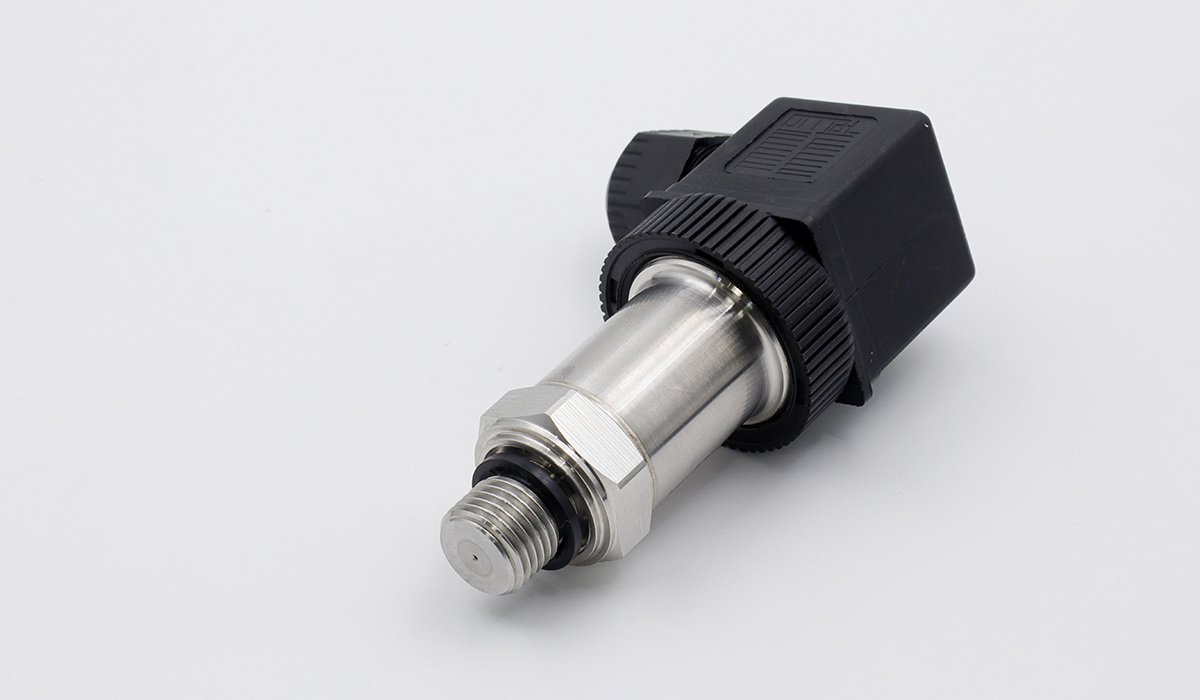
The working principle of pressure sensors is mainly based on the following physical effects:
1. Piezoresistive effect: When semiconductor materials are subjected to pressure, their electrical resistivity changes. By diffusing resistors on a silicon wafer and forming a Wheatstone bridge, when pressure is applied to the silicon film, the bridge generates an unbalanced voltage output, which is proportional to the pressure.
2. Piezoelectric effect: Some crystal materials (such as quartz and ceramics) generate charges when subjected to pressure, and the amount of charge is proportional to the applied pressure. This effect works without the need for an external power source and is suitable for dynamic pressure measurement.
3. Principle of capacitance change: A capacitor composed of two parallel plates changes its capacitance when pressure causes a change in the spacing between the plates. The pressure level can be determined by measuring the change in capacitance.
4. Electromagnetic induction principle: By utilizing the characteristic of pressure induced changes in the magnetic permeability of ferromagnetic materials, pressure is detected by measuring the changes in coil inductance.
5. Optical principle: Detecting pressure by measuring the optical signal changes caused by fiber deformation caused by pressure, suitable for harsh environments.
2、 Types and structural characteristics of pressure sensors
According to different measurement principles and application scenarios, pressure sensors can be divided into various types:
1. Strain gauge pressure sensor
Structural composition: elastic element (usually metal or silicon film), strain gauge (metal or semiconductor), Wheatstone bridge circuit
Working process: Pressure → Elastic element deformation → Strain gauge resistance change → Bridge output unbalanced voltage
Features: High precision, good stability, significant temperature impact
2. Piezoelectric pressure sensor
Core materials: quartz crystal, piezoelectric ceramics (PZT), etc
Signal output: Generate an amount of charge proportional to pressure
Advantages: Good high-frequency response, suitable for dynamic measurement, no need for external power supply
Limitations: Not suitable for static pressure measurement, high output impedance requires special amplifiers
3. Capacitive pressure sensor
Typical structure: A parallel plate capacitor is composed of a fixed electrode plate and a movable electrode plate (pressure sensitive diaphragm)
Sensitivity: inversely proportional to the square of the initial spacing, therefore a small spacing design can improve sensitivity
Advantages: low power consumption, good temperature characteristics, suitable for micro pressure measurement
Applications: Air pressure measurement, medical equipment, consumer electronics products
4. MEMS pressure sensor
Manufacturing process: Using microelectromechanical system technology to integrate mechanical structures and circuits on silicon wafers
Features: Small size, light weight, low cost, suitable for large-scale production
Typical applications: Automotive TPMS, smartphone altimeter, household appliance pressure control
3、 Key performance parameters of pressure sensors
When selecting a pressure sensor, the following core parameters should be considered:
1. Measurement range: The minimum to maximum pressure value that a sensor can measure, usually expressed in units such as Pa, kPa, MPa, or psi.
2. Accuracy: Refers to the deviation between the measurement result and the true value, usually expressed as a percentage of the full scale (such as ± 0.5% FS).
3. Sensitivity: The ratio of the change in output signal to the change in input pressure reflects the sensor's ability to respond to pressure changes.
4. Response time: The time required from pressure changes to the output signal reaching a stable value of 90%, reflecting dynamic characteristics.
5. Operating temperature range: The temperature range in which the sensor can operate normally. Exceeding this range may result in performance degradation or damage.
6. Long term stability: The ability of sensor performance parameters to remain unchanged over time under specified usage conditions.
7. Medium compatibility: The chemical compatibility between the material in contact with the sensor and the measured medium should be avoided to prevent corrosion or contamination.
8. Output signal types: Common include analog signals (4-20mA, 0-5V, 0-10V), digital signals (RS485, I2C, SPI), and wireless outputs.
4、 Selection Guide for Pressure Sensors
Choosing a suitable pressure sensor requires consideration of the following factors:
1. Measurement medium: gas, liquid, or special medium (corrosive, high viscosity, etc.), determining material selection.
2. Pressure type:
Gauge pressure (relative to atmospheric pressure);
Absolute pressure (relative to vacuum);
Differential pressure (the difference between two pressures);
Sealing reference pressure (relative to fixed reference pressure)
3. Environmental conditions: temperature, humidity, vibration, electromagnetic interference, etc., affect the selection of sensor protection level.
4. Accuracy requirements: 0.5% -1% FS for general industrial applications, 0.1% FS or higher for high-precision applications.
5. Output interface: Select analog output, digital output, or wireless transmission according to system requirements.
6. Installation methods: threaded installation, flange installation, embedded installation, etc., space limitations need to be considered.
7. Certification requirements: Depending on the industry application, explosion-proof certification (ATEX), medical certification (FDA), etc. may be required.